
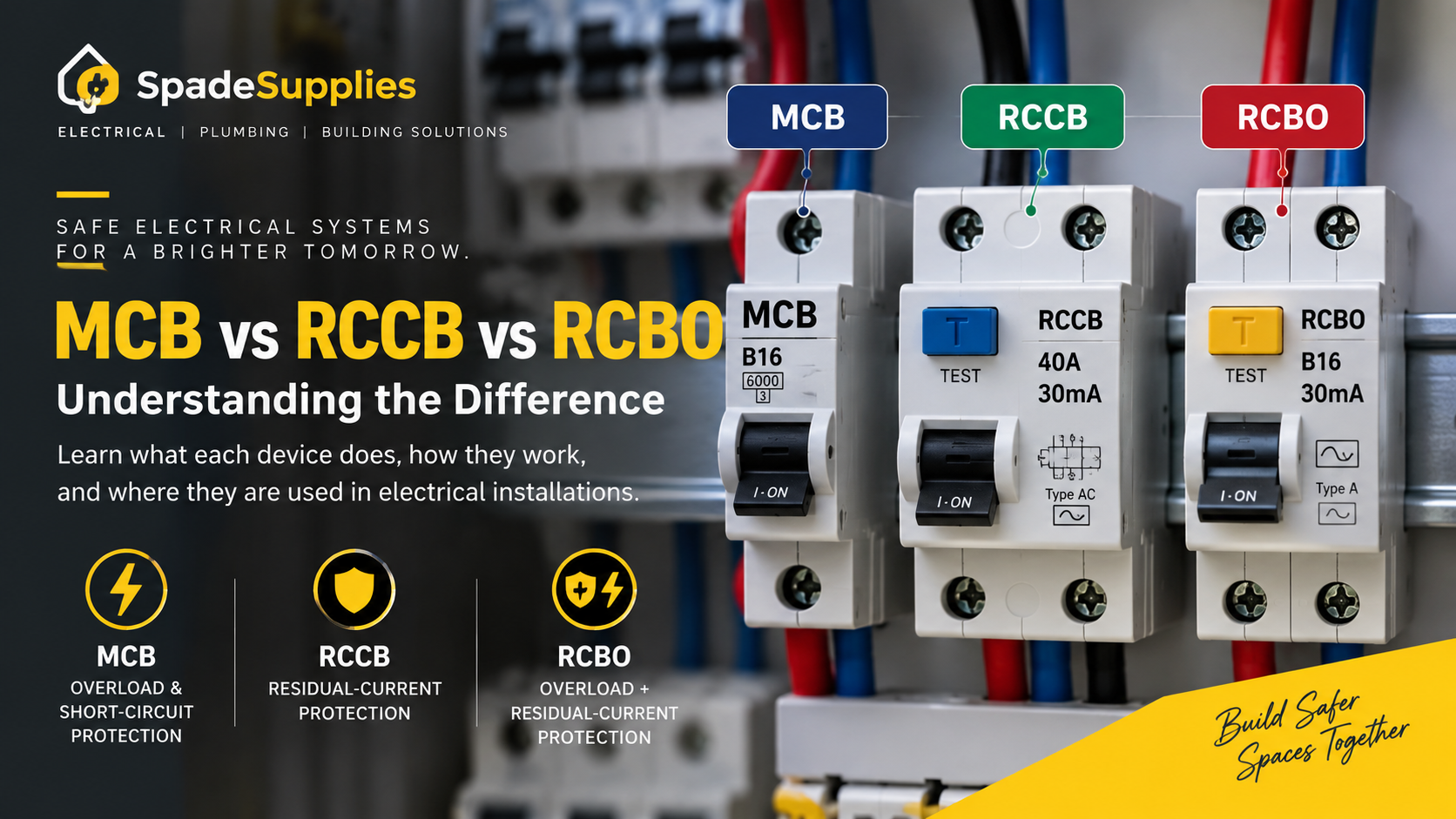

Electrical protection devices play an important role in every modern electrical installation.
If you have looked inside an electrical distribution board, you may have seen devices marked MCB, RCCB or RCBO.
Although these devices may look similar, they perform different functions.
Understanding the difference between MCB vs RCCB vs RCBO can help homeowners, electricians and project managers understand the role of each protection device.
Let’s look at each device in simple terms.
What Is an MCB?
MCB stands for Miniature Circuit Breaker.
An MCB is designed to protect an electrical circuit from excessive current.
It can respond to two common fault conditions:
- Overload
- Short circuit
For example, if a circuit continuously draws more current than its design allows, the MCB can trip and disconnect the supply.
Similarly, a short circuit can cause a very high current. The MCB is designed to interrupt this fault current.
MCBs are commonly used for lighting, socket and appliance circuits.
What Is an RCCB?
RCCB stands for Residual Current Circuit Breaker.
An RCCB is designed to detect residual current.
It monitors the current flowing through the relevant circuit conductors. If there is an imbalance, this can indicate that current is flowing through an unintended path.
The RCCB can then disconnect the circuit.
However, an RCCB does not provide integral overcurrent protection. Therefore, suitable overcurrent protection such as an MCB is normally required as part of the installation.
What Is an RCBO?
RCBO stands for Residual Current Breaker with Overcurrent Protection.
An RCBO combines residual-current protection with overcurrent protection in one device.
In simple terms, an RCBO combines functions associated with an RCCB and an MCB.
This makes RCBOs useful where an individual circuit needs both types of protection.
MCB vs RCCB vs RCBO
The easiest way to understand the difference is to look at what each device protects against.
| Device | Overload Protection | Short-Circuit Protection | Residual-Current Protection |
|---|---|---|---|
| MCB | Yes | Yes | No |
| RCCB | No | No | Yes |
| RCBO | Yes | Yes | Yes |
So, in simple terms:
MCB: Protects against excessive current.
RCCB: Detects residual current.
RCBO: Combines residual-current and overcurrent protection.
How Does an MCB Work?
An MCB continuously monitors the current flowing through a circuit.
Under normal conditions, the current remains within the expected range.
However, if the current becomes too high, the MCB operates and disconnects the circuit.
This helps protect the circuit conductors and connected installation from excessive current.
MCBs can also respond to short-circuit conditions.
How Does an RCCB Work?
An RCCB works by monitoring the current balance in the circuit.
Under normal conditions, the current flowing through the circuit should balance appropriately.
If some current takes an unintended path, an imbalance can occur.
The RCCB detects this residual current and can disconnect the supply.
This is why RCCBs are commonly associated with protection against electrical leakage.
How Does an RCBO Work?
An RCBO combines both functions.
It can respond to:
- Residual current
- Overload
- Short circuit
Therefore, an RCBO can provide comprehensive protection for an individual circuit using one protective device.
This can also help with circuit-level fault isolation.
MCB vs RCCB: What’s the Difference?
The main difference is the type of fault each device detects.
An MCB protects against overload and short circuits.
An RCCB provides residual-current protection.
An RCCB does not replace an MCB because it does not provide integral overcurrent protection.
For this reason, the two devices can be used together in an electrical installation.
MCB vs RCBO: What’s the Difference?
Both devices provide overcurrent protection.
However, an RCBO also provides residual-current protection.
| Feature | MCB | RCBO |
|---|---|---|
| Overload protection | Yes | Yes |
| Short-circuit protection | Yes | Yes |
| Residual-current protection | No | Yes |
| Individual circuit protection | Yes | Yes |
Therefore, an RCBO can provide two important protection functions in a single device.
RCCB vs RCBO: What’s the Difference?
The main difference is overcurrent protection.
An RCCB provides residual-current protection but does not include integral overcurrent protection.
An RCBO combines residual-current protection with overcurrent protection.
This means an RCBO can provide both functions for an individual circuit.
Why Is Individual Circuit Protection Useful?
Modern homes and commercial buildings contain many electrical circuits.
For example, a property may have separate circuits for:
- Lighting
- General sockets
- Air conditioners
- Water heaters
- Kitchen appliances
- Outdoor equipment
Using suitable protection for individual circuits can help isolate a fault to the affected circuit.
This can make troubleshooting and maintenance easier.
The exact protection arrangement should always be determined by the electrical design.
Where Are MCBs Commonly Used?
MCBs are commonly used to protect circuits against overcurrent.
Typical applications include:
- Lighting circuits
- Socket circuits
- Appliance circuits
- Small power circuits
- Distribution boards
The correct MCB rating and characteristics depend on the circuit design, load and installation conditions.
Where Are RCCBs Commonly Used?
RCCBs can be used where residual-current protection is required.
They may form part of residential, commercial and industrial electrical installations.
However, because an RCCB does not provide integral overcurrent protection, it needs to be coordinated with appropriate overcurrent protection.
Where Are RCBOs Commonly Used?
RCBOs are useful when an individual circuit needs both residual-current and overcurrent protection.
They may be considered for circuits supplying:
- Sockets
- Washing machines
- Water heaters
- Air conditioners
- Kitchen appliances
- Outdoor circuits
The correct RCBO should be selected according to the circuit requirements and applicable standards.
Which One Should You Use?
There is no single device that is suitable for every electrical circuit.
The correct choice depends on factors such as:
- Circuit load
- Cable size
- Electrical system
- Required residual-current protection
- Short-circuit conditions
- Installation arrangement
- Applicable standards
A qualified electrician should assess the installation before selecting or replacing protective devices.
Common Mistakes to Avoid
Choosing Only by Ampere Rating
A higher current rating does not automatically mean better protection.
The device must be correctly matched to the circuit and cable.
Assuming an RCCB Replaces an MCB
An RCCB provides residual-current protection.
It does not provide integral overcurrent protection.
Therefore, appropriate overcurrent protection is still required.
Choosing an RCBO Without Checking the Circuit
RCBO selection should consider the circuit’s load, wiring and protection requirements.
The correct device should be selected according to the complete installation design.
Quick Comparison
If you want a simple summary:
MCB = Overcurrent protection
RCCB = Residual-current protection
RCBO = Overcurrent + residual-current protection
Each device has a specific role.
Therefore, the right combination depends on the design and requirements of the electrical installation.
Frequently Asked Questions
Is an RCBO better than an MCB?
They perform different functions.
An MCB provides overcurrent protection, while an RCBO combines overcurrent and residual-current protection.
Can an RCCB replace an MCB?
No.
An RCCB does not provide integral overcurrent protection, so suitable overcurrent protection is still required.
Does an RCBO replace an RCCB?
An RCBO can provide residual-current and overcurrent protection for an individual circuit. However, the overall installation design determines which protection arrangement is appropriate.
What does RCBO stand for?
RCBO stands for Residual Current Breaker with Overcurrent Protection.
What does RCCB stand for?
RCCB stands for Residual Current Circuit Breaker.
What does MCB stand for?
MCB stands for Miniature Circuit Breaker.
Final Thoughts
MCB, RCCB and RCBO are important electrical protection devices, but they do not perform the same function.
An MCB protects against overload and short circuits.
An RCCB provides residual-current protection.
An RCBO combines residual-current and overcurrent protection.
Choosing the right device depends on the circuit, electrical system, connected load and installation requirements.
For electrical projects, always check the product specifications and consult a qualified electrical professional before installing or replacing protection devices.
Looking for MCBs, RCCBs, RCBOs and other electrical protection products?
Spade Supplies can help you find suitable electrical products for residential, commercial and project requirements.

