
How to Choose the Right MCB for Your Electrical Circuit
An MCB (Miniature Circuit Breaker) is one of the most common protection devices used in electrical installations.
It helps protect circuits from excessive current. It can also disconnect a circuit when a short circuit occurs.
However, choosing an MCB is not simply a matter of picking an ampere rating.
The MCB should match the circuit, cable, connected load and installation requirements.
So, how do you choose the right MCB?
Let’s look at the important factors.
What Is an MCB?
MCB stands for Miniature Circuit Breaker.
It is an automatically operated electrical switch designed to protect a circuit from excessive current.
An MCB can respond to conditions such as:
- Overload
- Short circuit
When a fault occurs, the MCB trips and disconnects the circuit.
This helps protect the electrical installation from damage caused by excessive current.
Why Is Choosing the Right MCB Important?
Every electrical circuit has a design limit.
If too much current flows through a circuit, the conductors can become excessively hot.
The protective device should therefore be selected to provide suitable protection for the circuit.
An MCB that is incorrectly selected may not provide the intended level of protection.
For this reason, MCB selection should be based on the complete circuit design.
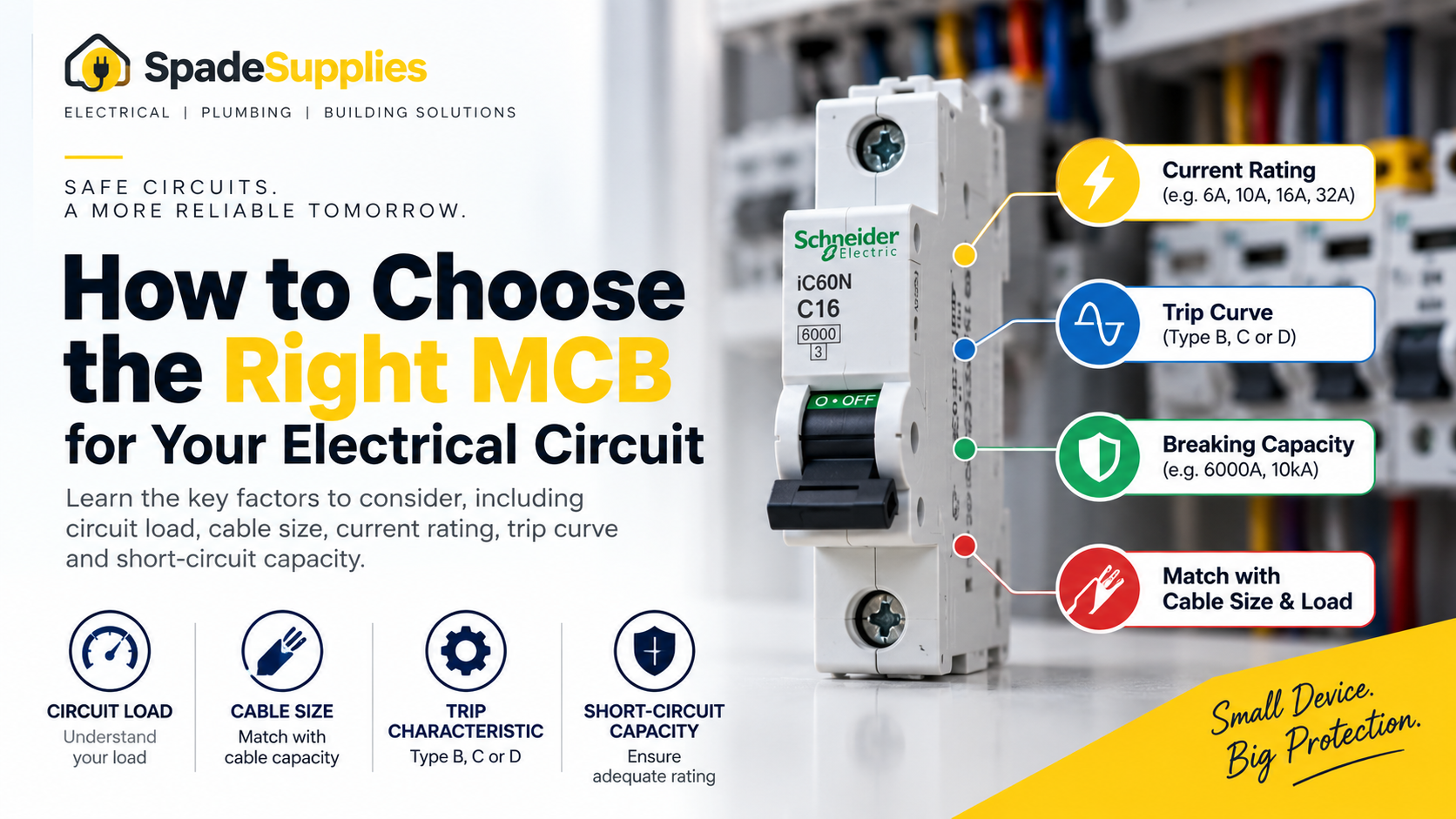
1. Determine the Circuit Load
The first step is to understand what the circuit will supply.
Different circuits can have different electrical loads.
For example:
- Lighting circuits
- Socket circuits
- Air conditioners
- Water heaters
- Kitchen appliances
- Motors and pumps
Each application can have different operating and starting characteristics.
Therefore, the expected load should be considered before selecting the MCB.
2. Check the Cable Size
The MCB should be properly coordinated with the cable.
The cable has a maximum current-carrying capacity that depends on factors such as:
- Conductor size
- Installation method
- Ambient temperature
- Number of loaded circuits
- Insulation type
The protective device should be selected so that the circuit conductors receive appropriate protection.
Therefore, do not choose an MCB based only on the appliance load.
The cable and installation conditions must also be considered.
3. Choose the Correct Current Rating
MCBs are available in different current ratings.
The rating indicates the current level associated with the MCB’s overcurrent protection characteristics.
For example, an installation may use MCBs with different ratings for different circuits.
However, choosing a higher-rated MCB is not automatically safer.
If the MCB rating is too high for the cable and circuit, the intended protection may not be achieved.
The rating should therefore be selected according to the circuit design.
4. Understand MCB Trip Curves
You may see MCBs described using trip characteristics such as:
- Type B
- Type C
- Type D
These characteristics relate to the MCB’s instantaneous magnetic tripping behaviour.
Different electrical loads can have different starting or inrush currents.
For example, some motors and equipment can draw a higher current when they start.
Therefore, the appropriate trip characteristic should be selected according to the application.
A qualified electrician can help determine the appropriate characteristic for the circuit.
5. Consider the Number of Poles
MCBs are available in different pole configurations.
Common configurations include:
- Single pole
- Double pole
- Three pole
- Four pole
The correct number of poles depends on the electrical system and circuit arrangement.
For example, a single-phase circuit and a three-phase circuit may require different arrangements.
The MCB should therefore match the electrical system being protected.
6. Check Short-Circuit Breaking Capacity
Another important specification is the MCB’s short-circuit breaking capacity.
The protective device must be capable of safely interrupting the prospective short-circuit current at the point where it is installed.
This value is important because short circuits can produce very high currents.
Therefore, the MCB’s breaking capacity should be checked as part of the electrical design.
7. Consider the Type of Electrical Load
Not every electrical load behaves in the same way.
A simple lighting circuit may have different characteristics from a motor circuit.
Similarly, equipment with high starting current may require a different MCB trip characteristic.
Before selecting an MCB, consider:
- Normal operating current
- Starting current
- Type of equipment
- Number of connected loads
- Circuit length
- Installation conditions
This helps ensure that the selected protection is suitable for the application.
8. MCB vs RCCB vs RCBO
It is also important to understand that an MCB is not the only type of electrical protection device.
An MCB provides overcurrent protection.
An RCCB provides residual-current protection.
An RCBO combines residual-current and overcurrent protection.
| Device | Overload Protection | Short-Circuit Protection | Residual-Current Protection |
|---|---|---|---|
| MCB | Yes | Yes | No |
| RCCB | No | No | Yes |
| RCBO | Yes | Yes | Yes |
Therefore, the correct protective device depends on the requirements of the circuit.
9. Check the Electrical Installation Requirements
MCB selection should also consider the overall installation.
Factors can include:
- Supply voltage
- Number of phases
- Earthing arrangement
- Cable characteristics
- Fault level
- Distribution board design
- Applicable electrical standards
The protective device should work correctly within the complete electrical system.
Common MCB Selection Mistakes
Choosing a Higher-Rated MCB
A common mistake is replacing an MCB with a higher-rated device without checking the cable.
A higher rating does not automatically provide better protection.
The MCB and cable should be properly coordinated.
Choosing Only by Price
Price should not be the only factor when selecting electrical protection equipment.
The MCB should also meet the required specifications and be suitable for the application.
Using the Same MCB for Every Circuit
Different circuits can have different loads and operating characteristics.
Therefore, the same MCB specification may not be appropriate for every circuit.
Ignoring Starting Current
Some equipment draws additional current when starting.
If this is not considered, the MCB may trip unnecessarily.
The correct trip characteristic should therefore be selected for the connected load.
MCB Selection Checklist
Before selecting an MCB, check the following:
- Circuit load
- Cable size
- Current rating
- Trip characteristic
- Number of poles
- Short-circuit breaking capacity
- Supply arrangement
- Installation conditions
- Applicable standards
Considering these factors can help ensure that the selected MCB is suitable for the circuit.
When Should You Ask an Electrician?
Electrical protection involves several technical considerations.
If you are installing a new circuit, changing an MCB or modifying a distribution board, it is best to have the installation assessed by a qualified electrician.
They can check the circuit load, cable, fault level and protective-device requirements.
This is especially important for high-load equipment and major electrical modifications.
Frequently Asked Questions
What is an MCB used for?
An MCB is used to protect an electrical circuit against excessive current caused by conditions such as overloads and short circuits.
How do I choose the correct MCB rating?
The correct rating depends on the circuit design, connected load, cable capacity and installation conditions.
The MCB should not be selected based only on the appliance’s rated power.
What is the difference between Type B and Type C MCB?
Type B and Type C refer to different instantaneous tripping characteristics.
The appropriate choice depends on the connected load and expected inrush current.
Can I replace a 16A MCB with a 20A MCB?
Do not make this change simply because the existing MCB trips.
The cable, circuit design and connected load should first be checked by a qualified electrician.
Does an MCB protect against electrical leakage?
An MCB is designed for overcurrent protection.
Residual-current protection is provided by devices such as RCCBs and RCBOs.
Can one MCB protect multiple circuits?
The correct arrangement depends on the electrical installation design.
Individual circuits often have their own protective devices so that faults can be isolated appropriately.
Final Thoughts
Choosing the right MCB requires more than selecting an ampere rating.
You should consider the circuit load, cable size, current rating, trip characteristic, number of poles and short-circuit breaking capacity.
The type of electrical equipment also matters.
Most importantly, the MCB should be correctly coordinated with the circuit it protects.
If you are installing or modifying an electrical system, consult a qualified electrician before selecting or replacing protective devices.
Looking for MCBs and other electrical protection products?
Spade Supplies can help you find suitable electrical products for residential, commercial and project requirements.